| A | B |
|---|
| lowest place on planet Earth | Dead Sea |
| contain every Old Testament book except Esther | Dead Sea Scrolls |
| found about fifty years ago by a young shepherd | Dead Sea Scrolls |
| publication has been delayed by politics and wars | Dead Sea Scrolls |
| hidden from the Romans in the 1st C. AD in clay pottery jars | Dead Sea Scrolls |
| translation from the Septuagint and Hebrew into the common language of the time, Latin | Vulgate |
| translation done for Greek-speaking Jews in the 3rd C. BC | Septuagint |
| abbreviation for the Septuagint | LXX |
| legend has it that seventy scholars worked on this translation | Septuagint |
| translation used by early Christan converts, most of whom were Greek-speaking | Septuagint |
| most popular translation in the English-speaking world for the past 400 years | King James Version |
| translation that was done as part of the Reformation | King James Version |
| commissioned by a Protestant monarch | King James Version |
| only one of the three translations we studied that does NOT include the New Testament | Septuagint |
| meaning of "canon" | official or authorized list |
| what "deutero-canonical books" refers to | seven Old Testament Books not contained in Jewish or Protestant Bibles. |
| meaning of "TaNaKh" | Hebrew word for the Bible, made up of the first letters for Torah, Neviim, and Ketubim |
| Christians divide the Old Testament into these four sections | Penteteuch, Historical Books, Prophets, Wisdom Books |
| The three divisions of the Tanach | Torah, Neviim, Ketubim |
| meaning of "neviim" | prophets |
| meaning of "Torah" | the Law |
| meaning of "ketubim" | the Writings |
| another name for the Deutero-canonical books | Apocrypha |
| two Old Testament books that are longer in Catholic Bibles because of deutero-canonical additions | Esther, Daniel |
| the seven deutero-canonical books | Wisdom, Sirach, Baruch, Tobit, Judith, 1&2 Maccabees
[A sentence to help you remember these: "Why So Blue, True Jew? 1 & 2!"] |
| 90 AD | when the canon for the TaNaKh was established |
| parchment | paper-like animal skins that gradually replaced papyrus as the material for writings |
| written "leaves" sewn together; replaced scrolls; ancestor of the book as we know it. | codex |
| section of the Old Testament that Christians recognize but which Jews blend in with the prophets | Historical books |
| 3rd century CE | when the Vulgate translation was done |
| 3rd century BCE | when the Septuagint translation was done |
| Church father who did the Vulgate translation | St. Jerome |
| time period when the King James Version was done | Renaissance--Reformation
early 1600s |
| "deutero-canonical" means | "second canon" or secondary canon" |
| example of a scroll |  |
| Qumran | place where the Dead Sea Scrolls were found. |
| photo showing the isolation of the Dead Sea |  |
| codex illustration |  |
| picture of the sponsor of the King James Version of the Bible |  |
| St. Jerome, translator of the Vulgate, who moved into the cave in Bethlehem where Jesus was born during the years he worked on the Vulgate. |  |
| photo of one of the caves at Qumran where the Dead Sea Scrolls were found | 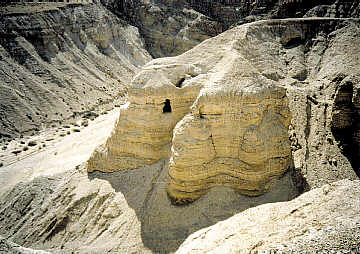 |
| Because of the high salt content, nothing can live--or sink--in the Dead Sea |  |



