| A | B |
|---|
* What part of the plasma membrane is "A" referring to?,  | hydrophilic region (phosphate heads of the phospholipid) p.79, |
| * What part of the plasma membrane is "B" referring to?, | hydrophobic region (fatty acid portion of the phospholipid bilayer) p.79, |
| * What part of the plasma membrane is "C" referring to?, | hydrophilic region (phosphate heads of the phospholipid) p.79, |
| * What is enclosed by the rectangle that "D" is pointing to?, | a phospholipid p.79, |
| * What is "E" pointing to?, | membrane proteins p.79, |
* What type of cell is being shown in this diagram?, 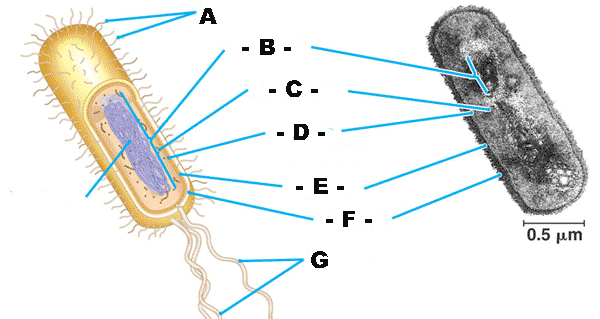 | prokaryotic cell p.78, |
| * What is "C" pointing to? Hint: They are tiny dot-like structures., | ribosomes p.78, |
| * What is "G" pointing to?, | flagella (the plural of flagellum) p.78, |
* What type of electron microscope produced this image?, 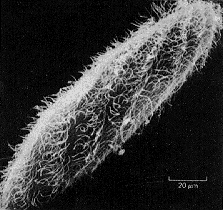 | scanning electron microscope (SEM) p.75, |
* What type of electron microscope produced this image?,  | transmission electron microscope (TEM) p.77, |
* The cell below is a(n) _____ cell.,  | animal p.80, |
* The cell below is a(n) _____ cell.,  | plant p.80, |
| * The ___ is the smallest unit of organization that can perform all activities required for life. | cell G-5 |
| * The first microscopes, as well as the microscopes that we use in lab, are called ____. | light microscopes (LM) p.75 |
| * ______ in microscopy is the ratio of an object's image size to its real size. | Magnification p.75 |
| * _____ is a measure of the clarity of an image under a microscope and is defined as the minimum distance that ______ can be separated and still be distinguished as _____. | Resolution, two points, two points p75 |
| * _________ microscopes focus a beam of electrons through the specimen or onto its surface. | Electron microscopes p75 |
| * The type of electron microscope that produces 3-D images of the surface of a specimen is called a ____. | scanning electron microscope (SEM) p.75, |
| * The type of electron microscope that produces a two dimensional picture of a thinly sliced cross section of a specimen is called a ______. | transmission electron microscope (TEM) p.77 |
| * What are four features that all cells, whether prokaryotic or eukaryotic, have in common? | Plasma membrane, cytosol, ribosomes, and chromosomes (although the structure of eukaryotic and prokaryotic chromosomes are quite different) p.77 |
| * The semifluid, jellylike substance in which organelles are found is called _____. | cytosol (Cytosol is often incorrectly called cytoplasm. Cytoplasm includes the cytosol, but also includes all of the undissolved structures like the organelles, other than the nucleus. The nucleus and everything inside it is not part of the cytosol or cytoplasm). p.77 |
| * The major reason that cells can't get too big is that as they get bigger, their _____ grows faster than their ____. | volume grows faster than their surface area (A cells requirement for nutrients and production of waste is proportional to its volume, but its ability to get nutrients in and waste out through the plasma membrane is proportional to the surface area of the plasma membrane) pp. 78 & 79 |
| * The ________ directs protein synthesis by synthesizing m-RNA according to instructions provided by ______. | nucleus, DNA p.822 |
| * The dark structure inside the nucleus is called the _____. It's job is to make the large and small subunits of ______. | nucleolus, ribosomes p.83, 
|
| * ________ are particles that carry out protein synthesis when _____ attaches to them to deliver the instructions. | Ribosomes, m-RNA p.84 |
| * Cells that have high rates of protein synthesis would have a large number of ______. | ribosomes p.84 |
| * Where would find free ribosomes ____________. | suspended in the cytosol p.84 |
| * Bound ribosomes would be found attached to the outside of the _____ or the _____. | endoplasmic reticulum or nuclear envelope p.84 |
* The "B" is pointing to ____ in the picture below.,  | the stroma of a chloroplast (like the cytosol of the chloroplast) p.91, |
| * The "E" is pointing to ____ in the picture below., | a single thylakoid in a chloroplast p.91, |
* What are the "A's" in the picture below?,  | transport vesicles p.89, |
| * What is the "B" in the picture below?, | The endoplasmic reticulum p.89, |
| * What is the "C" in the picture below?, | The golgi apparatus p.89, |
| * What is the "D" in the picture below?, | a bound ribosome (the little red dot) p.89, |
* What is "A" in the picture below?,  | A mitochondrion p.91, |
| * What is "B" in the picture below?, | the intermembrane space of the mitochondrion p.91, |
| * What is "C" in the picture below?, | the outer membrane of the mitochondrion p.91, |
| * What is "D" in the picture below?, | The inner membrane of the mitochondrion p.91, |
| * What is "F" in the picture below?, | the matrix of the mitochondrion (the inner compartment) p.91, |
| *The ______ ER does not have ribosomes attached to its outer surface. | smooth p.85 |
| * The ______ ER has ribosomes attached to its outer surface. | rough p.85 |
| * Which organelle is important in the synthesis of lipids, including steroid hormones, as well as phospholipids for membranes? | Smooth ER p.85 |
| * Most proteins that end up being secreted out of cells were originally made in the _____. | rough ER p.86 |
| * The _____ can be thought of as a center for warehousing, sorting, and shipping, and even some manufacturing. | golgi apparatus pp. 86 & 87 |
| * A(n) _____ is a membranous sac of hydrolytic enzymes that an animal cell uses to digest all kinds of macromolecules. | lysosome p.87 |
| * When lysosomes fuse with food vacuoles that are formed by endocytosis, the overall process of procurring and digesting the food is called ______. | phagocytosis p.87,  |
| * Mature plant cells contain a large _________ enclosed by a membrane called a tonoplast. | central vacuole p.88 |
| * Many freshwater protists contain a _____ vacuole that pumps water out of the cell. | contractile vacuole (The contractile vacuole in the paramecium below is the star-shaped organelle in the upper right end of the cell) p.88,  |
| * The ____ and _____ are organelles that convert energy into more useable forms for eukaryotic cells. | mitochondria and chloroplasts p.89 |
| * Which organelle is involved with cellular respiration? | mitochondria p.90 |
| * The mitochondria is involved with the process of _____. | cellular respiration p.90 |
| * The chloroplast is involved with the process of _____. | photosynthesis p.91 |
| * Which organelle is involved with photosynthesis? | chloroplast p.91 |
| * The flattened interconnecting sacs inside chloroplasts are called ____. | thylakoids ("E" in the picture below) p.91, |
| * The space between the thylakoids and the inner membrane of the chloroplast is called the ____. | stroma p.92 |
| * The green photosynthetic pigment in _____ is called _____. | chloroplasts, chlorophyll p.91 |
| * _____, especially prominant in the liver, help detoxify alcohol and other poisons by transferring hydrogen from the poisons to oxygen, producing hydrogen peroxide. | Peroxisomes p.92 |
| * Hydrogen peroxide produced in peroxisomes during oxidative reactions is quickly broken down by ____, also produced by peroxisomes. | catalase (This info is not in the chapter, but it is the enzyme we are doing a major research project on, so you should know it) |
| * The _______ is a network of fibers that organizes structures and activities of the cell. | cytoskeleton p.92, 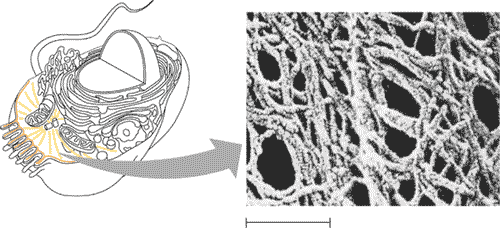 |
| * Many single-cell organism have either _____ or ______, both with the same "9 + 2" arrangement of microtubules, to help propel them through the water. The ____ are the longer of the two. | cilia, flagella, flagella are longer (The picture below is a photosynthetic protist called Euglena that uses its flagellum to move through water) p.94,  |
| * The cell wall of plants is made mostly of ______. | cellulose p.97 |
| * In prokaryotic cells, where is the DNA located? | In the nucleoid region out in the cytosol p.78 |
| * In eukaryotic cells, where is the DNA located? | In the nucleus (although some organelles, like chloroplasts and mitochondria, contain small amounts of their own DNA) p.82 |
| * The major difference between prokaryotic and eukaryotic cells is that prokaryotic cells do not store their DNA inside a(n) ____ and they lack other ____ organelles as well. | nucleus, membrane-bound organelles (Ribosomes, which are found in both types of cells, are not membrane-bound. Instead, they can best be described as solid structures with no interior region) p. 77 |
| * What does the root word "cyto-" mean? | Cell (For example, cytology is the study of cells |
| * What does the root word "pseudo-" mean? | false (Since "pod" means foot, a pseudopod means "false foot." Amoebas, like the one below, have pseudopods. They are the extensions of the cell that expand and contract to help the amoeba move around and grab food particles to phagocytize),  |



