| A | B |
|---|
| * During development of multicellular organisms, cells undergo a process of becoming specialized in structure and function in a process called ________. | cell differentiation (this involves activating certain genes and permanently silencing others, such as genes for liver proteins in a pancreas cell) p328 |
| * Cancer causing genes are called _____. | oncogenes (the normal version of these cellular genes are called proto-oncogenes. They are usually involved with normal stimulation of cell growth and division. These genes are ones that commonly mutate to form oncogenes) p341 |
| * ______ code for proteins that stimulate normal cell growth and division, but can be turned into a cancer-causing gene by mutations. | proto-oncogenes p340 |
| * The first sign of cancer may be a small benign growth called a(n) ______. | polyp pp342&343, 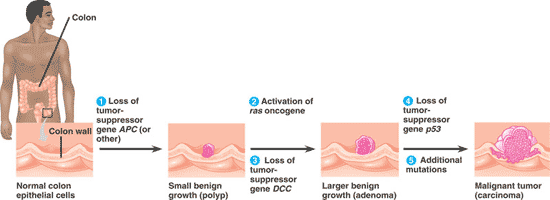 |
| * A tumor large enough to impair function of one or several organs is called a(n) ______ tumor. | malignant tumor (Malignant tumors are also referred to as carcinomas. Malignant tumors are also capable of breaking off pieces of the tumor that then travel to other places in the body through the blood or lymphatic systems and developing into new tumors, a process called metastasis) p343, |
| * An individual ______ an oncogene or mutant allele of a tumor-suppressor gene is one step closer to accumulating the necessary mutations for cancer to develop by the _____ model of cancer development. | inheriting, multistep pp342&343, |
| * A gene found in viri or as a mutated form of normal gene that is normally involved with regulating the cell cycle, but now is involved in triggering cancerous characteristics. | oncogene p340 |
| * A normal cellular gene corresponding to an oncogene; a gene with the potential to cause cancer, but that requires some alteration to become an oncogene. | proto-oncogene p373 |
| * A gene whose protein products inhibit cell division, thereby preventing uncontrolled cell growth (cancer). | tumor-suppressor gene p341 |
| * The end of an animal that is near the head is called the _______ end. | anterior p333 |
| * The end of an animal that is near the tail is called the _______ end. | posterior p333 |
| * The belly of an animal is said to be on the ______ side of the body. | ventral p333 |
| * The back of an animal is said to be on the ______ side of the body. | dorsal (Think about the dorsal fin of a shark sticking out of the water) p333 |
| * Maternal substances in the egg that influence the course of early development are called ___________. | cytoplasmic determinants p328 |
| * What are the two sources of information that tell a cell which genes to express at any given time during embryonic development? | 1) Cytoplasmic determinants in the egg. 2) Induction by nearby cells pp328&329, 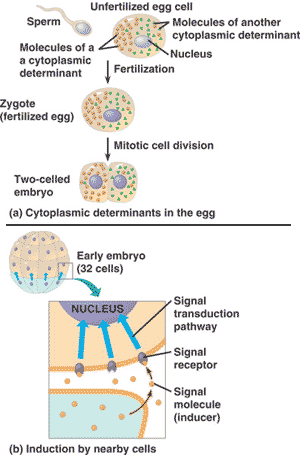 |
| * Even before fertilization in Drosophila, neighboring nurse cells cause localization of _______ mRNA at one end of the egg, thus helping to establish the anterior end of the future embryo. | bicoid p334, 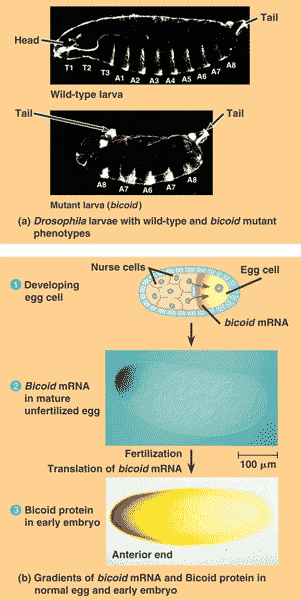 |
| * In the process of ______, a target cell is stimulated to differentiate its gene expression through signals from adjacent or nearby cells during embryonic development. These signals from nearby cells may be in the form of cell-surface molecules on adjacent cells and/or the binding of growth factors secreted by nearby cells. | induction p329 |
| * In Drosophila, _________ is an example of a cytoplasmic determinant. | bicoid mRNA (The term "morphogen" can also apply because the bicoid mRNA forms a gradient that helps establish the developmental axes. The term "Bicoid" by itself refers to the protein product of bicoid m-RNA that gets translated once the egg is fertilized. Bicoid is also a morphogen, but is not a cytoplasmic determinant, because it did not enter the egg from the mother's cells) p334, |
| * In Drosophila, bicoid mRNA is an example of a __________. | cytoplasmic determinant (The term "morphogen" can also apply because the bicoid mRNA forms a gradient that helps establish the developmental axes. The term "Bicoid" by itself refers to the protein product of bicoid m-RNA that gets translated once the egg is fertilized. Bicoid is also a morphogen, but is not a cytoplasmic determinant, because it did not enter the egg from the mother's cells) p334, |
| * During development, certain cells are meant to die instead of divide. This programmed cell death is called ______. | apoptosis p330 |
| * Any of the master regulatory genes that control placement and spatial organization of body parts in animals, plants, and fungi by controlling the developmental fate of groups of cells is called a(n) ______. | homeotic gene p371 ,G-14 |
| * Once an embryonic cell has undergone ______, it is irreversibly committed to its normal fate. | determination p329 |
| * The molecular cues that control pattern formation, collectively called positional information, include ______ and ________. | cytoplasmic determinants, inductive signals p332 |
| * The products of _____ genes are cytoplasmic determinants. These include proteins and/or RNA that are produced by the mother and enter the egg but don't spread out evenly in the egg. The different concentration of these substances in the egg lead to the establishment of the axes in the developing embryo. | maternal effect genes (a.k.a. - egg polarity genes) p334 |
| * The products of maternal effect genes are ______. These include proteins and/or RNA that are produced by the mother and enter the egg but don't spread out evenly in the egg. The different concentration of these substances in the egg lead to the establishment of the axes in the developing embryo. | cytoplasmic determinants p334 |
| * The products of maternal effect genes are cytoplasmic determinants. These include ____ and/or ____ that are produced by the mother and enter the egg but don't spread out evenly in the egg. The different concentration of these substances in the egg lead to the establishment of the axes in the developing embryo. | proteins, RNA p334 |
| * A gene classified as a maternal effect gene is one that, when mutant in the mother, results in a mutant _____ in the offspring regardless of the offspring's own genotype. | phenotype (This is because they act as or encode for cytoplasmic determinants in the egg that establish the axis of development in the embryo) p334 |
| * Any relatively unspecialized cell that can produce, during a single division, one identical daughter cell and one more specialized daughter cell that can undergo further differentiation. | stem cell p336 |
| * A stem cell with the ability to differentiate into any type of cell that makes up an organism is said to be ______. | totipotent p336 |
| * A stem cell with the ability to differentiate into many, but not all of the types of cells that makes up an organism, is said to be ______. | pluripotent p339 |
| * Cloning of animals often times involves a procedure called ______ in which the nucleus of a(n) ____ cell is removed and replaced with the nucleus of an adult cell from the animal that you want to clone. | nuclear transplantation, egg cell p336 p413, 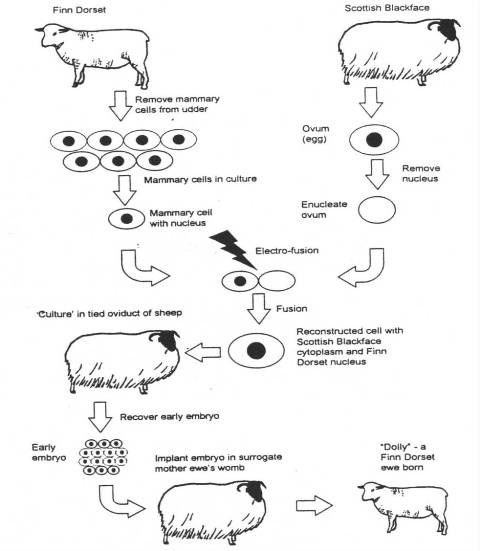 |



