| A | B |
|---|
| * True or False: Individual organisms evolve. | FALSE (Although natural selection acts upon individuals, only populations evolve as organisms can't acquire new adaptations after they start to develop.) p420 |
| * _____________ is change in the allele frequencies in a population over generations. | Microevolution |
| * The _________ consists of all copies of every type of allele at every locus in all members of the population | gene pool p424 |
| * The Hardy-Weinberg theorem describes a population that is _________. | not evolving p424 |
| What is the Hardy-Weinberg equation? | . p426, 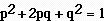 |
| * In the Hardy-Weinberg equation, p + q =____ | 1 (remember, p and q represent the frequencies of the two alleles being considered. Their frequencies have to add up to 1, or 100%) pp424 - 427 |
| * In the Hardy-Weinberg equation, p squared and q squared equal the frequencies of the ________ genotypes. | homozygous pp424 - 427 |
| * In the Hardy-Weinberg equation, 2pq equals the frequencies of the ________ genotype. | heterozygous pp424 - 427 |
| ** If the percentage of blue eye alleles in a population is 60%, what percentage of the population is expected to have blue eyes? | 36% (Blue is recessive, so q = .6. Therefore, q squared = .36) pp424 - 427 |
| ** If the percentage of blue eye alleles in a population is 70%, what percentage of the population is expected to have brown eyes? | 51% (Blue eyes are recessive, so q = .7. Therefore, the frequency of blue eyed people in the population = q squared = .49. The rest are browned eyed, so their frequency = 1.0 - .49 = .51, or 51%) pp424 - 427 |
| ** If 64% of the population has blue eyes, what is the frequency of the blue allele in the gene pool? | 80% (Since blue is recessive, and q squared is the frequency of the recessive trait in the population, q squared = .64. Therefore, q, the frequency of the blue allele = the square root of q squared = the square root of .64 = .8 = 80%) pp424 - 427 |
| ** If 16% of the population has blue eyes, what percentage of the population is heterozygous for brown eyes? | 48% (Since blue is recessive, and the frequency of blue eyes in a population = q squared = .16, the frequency of the blue allele is the square root of q squared = the square root of .16 = .4. Therefore, p, the frequency of the brown allele is 1.0 - .4 = .6. The frequency of the heterozygous population is 2pq = 2 X .4 X .6 = .48 = 48%) pp424 - 427 |
| ** If 9% of the population has blue eyes, what percentage of the population is homozygous for brown eyes? | 49% (Since blue is recessive, and the frequency of blue eyes in a population = q squared = .09, the frequency of the blue allele is the square root of q squared = the square root of .09 = .3. Therefore, p, the frequency of the brown allele is 1.0 - .3 = .7. The frequency of the homozygous brown eyed population is p squared = .7 squared = .49 = 49%) pp424 - 427 |
| ** If the frequency of the blue eyed allele in a population is 25%, what is the frequency of the brown eyed allele? | 75% (There are only 2 alleles for human eye color, so if 25% of them are blue, the rest are brown) pp424 - 427 |
| ** What are the five conditions that must be met in order to maintain Hardy-Weinberg equilibrium? | 1) Large population size. 2) No gene flow. 3) No mutations. 4) No natural selection. 5) Random mating. p426 |
| * _______ are changes in the nucleotide sequences of DNA. | Mutations p422 |
| * A _____ mutation is a change in one base in a gene. | point mutation p422 |
| ** Sickle-cell anemia is caused by which type of mutation? | A point mutation. p422 |
* What type of mutation is shown in the picture below?,  | Chromosomal deletion, |
| * _______ is the main cause of differential success in reproduction. | Natural selection p431 |
| * _______ is defined as random deviation from the expected allele frequencies over time | Genetic drift p428 |
| * ______ populations are the most susceptible to the effects of genetic drift. | Small p428 |
| * A sudden change in the environment that causes a drastic reduction in the size of population, causing the remaining gene pool to be significantly different from the original gene pool. | The bottleneck effect p429 |
| * The ______ is caused by a few individuals becoming separated from the larger population, often leading to a different genetic makeup in subsequent generations compared to the gene pool of the original population. | The founder effect p428 |
| * _________ results from the migration of fertile individuals or gametes between populations. | Gene flow p430 |
| ** Gene flow tends to _______ differences between populations over time. | reduce p430 |
| * _______ is the contribution an individual makes to the gene pool of the next generation, relative to the contributions of other individuals. | Relative fitness p431 |
* Which type of selection effect does the graph below show?,  | Directional p432, |
* Which type of selection effect does the graph below show?,  | Disruptive p432, |
* Which type of selection effect does the graph below show?,  | Stabilizing p432, |
| ** _________ selection occurs when natural selection maintains stable frequencies of two or more phenotypic forms in a population. | Balancing p433 |
| ** _______ describes situations in which individuals who are heterozygous at a particular locus have greater fitness than homozygotes. | Heterozygous advantage p433 |
| * The sickle-cell allele causes mutations in hemoglobin but also confers resistance to _______. | malaria pp434&435 |
| * The sickle-cell allele causes mutations in ______ but also confers resistance to malaria. | hemoglobin pp434&435 |
| ** A classic example of heterozygous advantage is the _____. | sickle-cell allele p433 |
| ** In _______ selection, the fitness of any morph declines if it becomes too common in the population. This usually involves a predator that learns to prey on the most common morph of a prey species. | frequency-dependent selection p436 |
| ** _______ variation is genetic variation that appears to confer no selective advantage (for example, human eye color) | Neutral p422 |
| ** Genetic variation in the untranslated parts of the genome is an example of _____ variation because it appears to confer no selective advantage. | neutral p422 |
| * Selection due to the sexual preferences of males or females within a species is called __________. | sexual selection p436 |
| ** Marked differences between the sexes in secondary sexual characteristics is called ______. | sexual dimorphism (for example, humans are sexually dimorphic whereas most fish are not) p436 |
| ** __________ selection is a direct competition among individuals of one sex for mates of the opposite sex. | Intrasexual selection p436 |
| ** __________ selection occurs when individuals of one sex (usually females) are choosy in selecting their mates from individuals of the other sex. | Intersexual selection p436 |
| ** Genetic variation at the whole gene level (gene variability) can be quantified as the average percent of loci that are ______. | heterozygous p421 |
| * Phenotype is the product of both inherited genotype and ______ influences. | environmental p421 |
| * Natural selection can only act on phenotypic variation that has a _____ component. | genetic p421 |
| ** Genetic variation results when new alleles and genes are produced through ____________, gene ____________, or other processes | mutations, duplications p.422 |
| ** ________ creates genetic variation by arranging existing genes in new ways | Sexual reproduction p423 |
| * In diploid organisms, harmful alleles that are _____ can be hidden from natural selection. | recessive p422 |
| * In multicellular organisms, only mutations in cell lines that produce ____ can be passed on to offspring. | gametes p423 |



