| A | B |
|---|
| Molecules are held together by _____ bonds. | covalent |
| A(n) ______ is held together by covalent bonds. | molecule |
| Two formulas can be used to describe hydrogen peroxide. HO, and H2O2. Which one is the molecular formula and which is the empirical formula? What's the difference between these types of formulas? | HO is the empirical formula. Empirical formulas show the lowest common ratio of elements in a compound while molecular formulas indicate the actual number of atoms of each type in a molecule. |
| Diatomic molecules consist of ____ | 2 atoms bonded together. |
| Which elements are found in diatomic form in nature? | hydrogen, nitrogen, oxygen, flourine, chlorine, bromine and iodine (remember the heavenly 7. See periodic table) |
| Polar molecules have a ______ end and a ______ end. | partial positive, partial negative |
| ______ molecules have a partial positive end and a partial negative end. | polar |
| _____ molecules can't be divided into poles of opposite charge. | Non-polar |
| Organic molecules contain _____ and _____ and were originally made inside living things. | carbon, hydrogen |
| _______ molecules contain carbon and hydrogen and were originally made inside _______. | organic, living things |
| Chemical compounds tend to form so that each atom, by _________, ________, or _________ electrons, has an ________ of electrons in its highest energy level. | gaining, losing, or sharing electrons, octet |
| Electron dot notation uses dots around the element's symbol to show the element's ______. | outer shell electrons (a.k.a. valence electrons) |
| Lewis structures are like electron dot notation, except they show _______ instead of _______. | molecules, elements |
| Electrons in the outer electron shell that are not involved with bonding are called ______. | lone pair electrons |
| The structural formula shows ______. | Just the symbols of the elements in a compound with dashes to symbolize bonds (The one in the middle is a structural formula. The other two are Lewis structures), 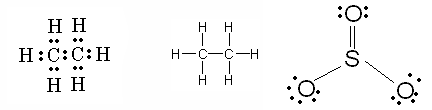 |
| How would you show the formation of a covalent compound using electron dot notation and Lewis structures? Use the formation of bromine as an example. | ., 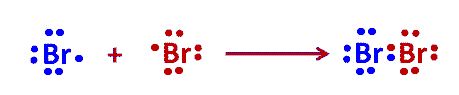 |
| Ionic compounds are made of individual _____. | ions |
| Draw the formation of the ionic compound NaCl from a sodium atom and a chlorine atom. | .,  |
| A charged group of covalently bonded atoms is called a(n) ___________. | polyatomic ion (Examples include |
| Which of the following molecules are diatomic? CO (carbon monoxide) or 0=0 (elemental oxygen, O2) | They both are (They both contain exactly 2 atoms and they are held together by covalent bonds, making them molecules) |
| Which of these diagrams is a structural formula and which is a Lewis structure?, | The one in the middle is a structural formula and the outer ones are Lewis structures (Notice that structural formulas show no dots, just bonds represented by dashes), |
| Positively charged ions are called ______. | cations |
| Negatively charged ions are called ______. | anions |
| Ionic compounds are made of individual _____. | ions |
| Most ionic compounds exist as _______ solids. | crystalline (crystals) |
| Ionic compounds tend to have _____ melting and boiling points than molecular compounds. | higher |
| Ionic compounds tend to be hard but _____. | brittle |
| Ionic compounds tend to be ______ electrical conductors in the solid state. | poor (this is due to the fact that the ions can't move to conduct electricity) |
| Molecular compounds tend to have relatively ______ forces between molecules. | weak |
| Molecular compounds tend to melt and boil at relatively _____ temperatures. | low |
| A charged group of covalently bonded atoms is called a(n) ___________. | polyatomic ion |
| Which diagram(s) below are structural formulas and which are Lewis structures?, | The outer two diagrams are Lewis structures. The middle structure is a structural formula. Structural formulas do not show valence electrons. Lewis structures show all valence electrons as dots. They can show the bonds as either lines or pairs of electron dots., |
| Metals tend to have the physical property of being shiny, otherwise known as _______. | luster |
| Metals tend to have the physical property of being ______, otherwise known as luster. | shiny |
| Metals have the physical property of being able to be stretched into thin wire, otherwise known as _______. | ductility |
| Metals have the physical property of being able to be hammered into thin sheets, otherwise known as _______. | malleability |
| Metals are good ______ conductors because their "sea" of mobile electrons can easily move. | electrical |
| Metals are good ______ conductors because their "sea" of mobile electrons can move easily, transferring energy from one part of the metal to other parts. | thermal |
| Electrons in _______ are said to be delocalized, which means that they do not belong to any one atom but move freely about empty orbitals of all the atoms in the object. | metals |
| Electrons in metals are said to be ________, which means that they do not belong to any one atom but move freely about empty orbitals of all the atoms in the object. | delocalized |
| The mobile electrons in a ______ form a "sea of electrons" around the atoms in the object. | metal |
| The mobile electrons in a metal form a "__________" around the atoms in the object. | sea of electrons |
| The chemical bonding that results from the attraction between metal atoms and the surrounding sea of electrons is called ______ bonding. | metallic |
| _______ forces are the forces of attraction between molecules. | Intermolecular |
| Intermolecular forces are the forces of attraction _________ molecules. | between |
| To change from a liquid to a gas, molecules must be able to escape the _________ that attract each molecule to its neighboring molecules in the liquid. | intermolecular forces |
| Molecules with greater intermolecular forces between them have _____ melting and boiling points. | higher |
| Covalent bonds that hold atoms together within a molecule are called ______ forces. | intramolecular ("intra" means "within" while "inter" means "between.") |
| The intermolecular forces that attract one molecule to another molecule are generally ____ than the intramolecular forces that attract atoms to each other within the same molecule. | weaker |
| Covalently bonded substances generally have _____ melting and boiling points than ionically bonded substances because _______ between molecules are generallly weaker than the ionic bonds that hold ionic substances together. | lower, the intermolecular forces (when molecules melt or boil, the covalent bonds that hold a molecule don't break like the ionic bonds of ionic substances. Instead, the weaker intermolecular bonds break, allowing molecules to move relative to their neighboring molecules) |
| The strongest intermolecular forces exist between ______ molecules. | polar |
| What are the three general types of intermolecular forces? List the strongest type first and the weakest type last. | 1) Dipole-dipole 2) Dipole-induced dipole 3) induced dipole - induced dipole (a.k.a. London Dispersion Forces) |
| Another name for intermolecular forces is _________. | Van der Waals forces |
| Another name for Van der Waals forces is ______. | intermolecular forces |
| Another name for induced dipole - induced dipole forces is ______. | London Dispersion forces. |
| Another name London Dispersion forces is ______. | induced dipole - induced dipole forces. |
| What is the strongest type of intermolecular force? | dipole - dipole forces |
| Dipole - dipole forces exist between a _____ molecule and a _____ molecule. | polar, polar |
| Dipole - Induced Dipole forces exist between a _____ molecule and a _____ molecule. | polar, non-polar |
| Induced Dipole - Induced Dipole forces exist between a _____ molecule and a _____ molecule. | non-polar, non-polar |
| The weakest type of intermolecular force is a(n) ______. | induced dipole -induced dipole force (a.k.a. - London Dispersion Force) |
| Polar molecules are said to have a ______ which is created by equal but opposite charges in different ends of the molecule. | dipole |
| A particularly strong type of dipole - dipole force that is caused by the attraction of hydrogen bonded to either oxygen, nitrogen or fluorine in one molecule, and either oxygen, fluorine, or nitrogen atoms in another molecule. | hydrogen bonds (the pink dotted lines in the picture below represent hydrogen bonds that hold complementary nucleotides together in DNA),  |
What are three words to describe the bonds between the water molecules (represented by the black dotted lines) in the picture below? List them in order from least specific to most specific.,  | Intermolecular (or Van der Waals) forces, dipole - dipole force, hydrogen bond, |
| The tendency of certain liquids (like water) to move up a narrow tube due to the attraction of the liquid molecules to the surface of the tube is called _________. | capillary action, 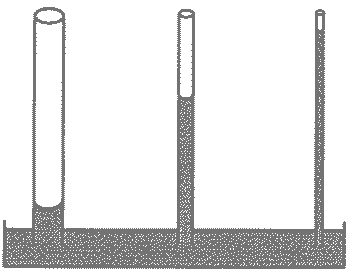 |
Water tends to bead up do to ______ of the molecules within the bead. This term means "sticking to self.",  | cohesion, |
| A polar molecule can _____ a dipole in a nonpolar molecule by temporarily attracting its electrons to one side of the non-polar molecule. | induce |
When molecules stick to the side of a surface (like the water molecules in the side of the menscus below sticking to the glass in the graduated cylinder), they are exhibiting the property of ______.,  | adhesion (the water molecules are adhering to the glass, causing the meniscus to rise up slightly on the sides), |
The water strider in the picture below doesn't break through the surface of the water because of the strong ________ caused by hydrogen bonding of water molecules at the surface.,  | surface tension, |
| Water is best at dissolving ____ and ____ substances. | polar, ionic |
| Water (a polar molecule) is able to dissolve oxygen gas (a non-polar molecule) because of which type of intermolecular force between the two? | dipole - induced dipole |



