| A | B |
|---|
| Gothic period lasted | mainly from the 12th c. to the end of the 15th c. |
| The term "Gothic" came from the fact that | it did not conform to traditional standars, so was named after barbarians |
| Romanesque style did not die but evolved into | Gothic style |
| Romanesque style was heavy and dark, whereas | Gothic style emphasized light and grace, even frailty |
| the pointed arch held an advantage over the roman arch because | it reduced thrust (sideways pressure) |
| buttress | a support or brace that counteracts the thrust of an arch or vault |
| thrust-counterthrust system which supported Gothic ceilings | consisted of arches, piers, and flying buttresses |
| Stained-glass windows became more prominent in Gothic cathedrals | because less surface area of the wall was dedicated to supporting the celing |
| Gothic Churches represented the | clergy and community of the town where they were built |
| the Gothic style originated in | France |
| Gothic sculpture became more | realistic than earlier medieval examples |
| gargoyles | grotesque flying monsters that project out from the upper portions of huge churches (waterspouts) |
| illustrated books | became more widespread during the Gothic era |
| Book of Hours | luxurious book of prayers produced for the Duke of Berry in the 15th c. |
| Duccio | Italian church painter/painted Maestà Altarpiece at the Cathedral of Siena |
| Giotto | Italian church painter/known for fresco painting |
| fresco | painting created when pigment (color) is applied to a wall spread with fresh plaster |
| Giotto painted primarily in | Padua |
| Giotto painted _____________ | realistically |
| Duccio painted _____________ | with Byzantine conservatism |
| apse | altar area of the cathedral |
| bay | the rectangular ceiling area between four piers |
| capital | top sections of carved pillars or columns |
| centerings | temporary wooden frames used for support during construction |
| choir | portion of cathedral in front of the apse |
| clerestory | portion of cathedral walls above the triforium with tall windows |
| flying buttress | stone arches connecting each buttress to a pier |
| foliage | carved vines and leaves adorning some capitals |
| mullions | stone window frames used to support stained glass windows |
| crypt | a vault under a church, whether used for burial purposes or for a subterranean chapel (oratory) |
| piers | stone columns rising from the foundation which support the cathedral |
| ribs | arched stone ceiling supports which replaced centerings |
| rose window | large round window, usually found in teh west facade of a Gothic cathedral |
| tracery | stone framework of the cathedral windows |
| transept | side portions of the cathedral interior jutting out from the central crypt |
| triforium | part of the walls composed of a row of arches between the piers and clerestory |
| typanum | semicircular stone panel above a lintel under an arch |
| voussoirs | the single cut stones of the ribs |
| facade | face of a building, especially the principal face |
| flamboyant | wavy lines/flamelike forms found in 15th- and 16th-century French Gothic architecture |
| relief sculpture | sculpture carved into a flat background |
| chivalry | medieval syste, principles, and customs of knighthood |
| pilaster | flat, rectangular columns atttached to a wall |
| pietà | representation of the Virgin Mary mourning over the body of Christ |
| jambes/jambs | vertical posts or pieces that form the sides of a door, window frame, fireplace, etc. |
| fan vaulting | ribbing that on a flat surface would form a circle, 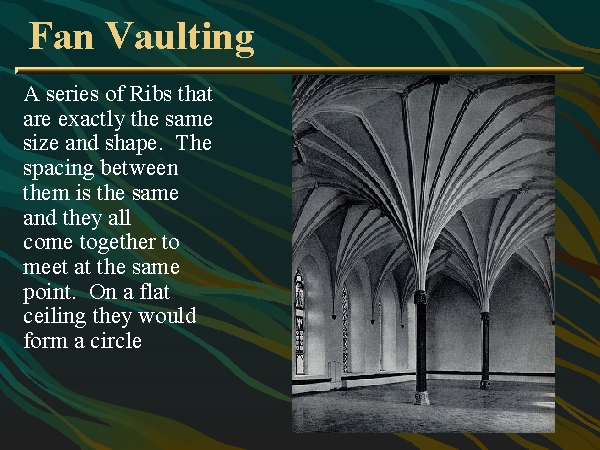 |
| trumeau | beam in the center of a door way, between the actual doors, 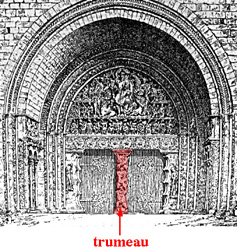 |
| archivolt | bands surrounding an arched opening,  |


