| A | B |
|---|
Astronomy,  | The study of the moon, stars and other objects in space. |
| Axis | An imaginary line that passes through Earth's center and the North and South poles, about which Earth rotates. |
Rotation, 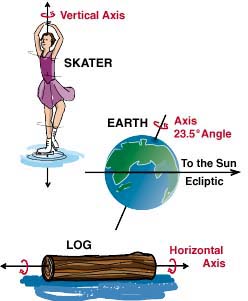 | The spinning motion of a planet about its axis. |
Revolution, 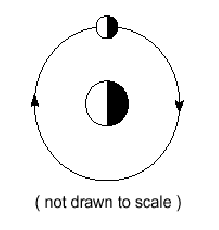 | The movement of an object around another object. |
| Orbit | The path of an object as it revolves around another object in space. |
Latitude,  | The distance north or south from the equator, measured in degrees. |
| Solstice | The two days of the year on which the noon sun is directly overhead at either 23.5^ south or 23.5^north. |
| Equinox | The two days of the year on which neither hemisphere is tilted toward or away from the sun. |
| Vernal Equinox | The day that marks the beginning of spring in the Northern Hemisphere. |
| Autumnal Equinox | The day of the year that marks the beginning of fall in the Northern Hemisphere. |
| Summer Solstice | June 21 in Northern Hemisphere; December 21 in Southern Hemisphere. |
| Winter Solstice | December 21 - Northern Hemisphere; June 21 in Southern Hemisphere. |
| Eclipse | The partial or total blocking of one object by another. |
| Umbra | The darkest part of a shadow. |
| Penumbra | The part of a shadow surrounding the darkest part. |
| Lunar Eclipse | The blocking of sunlight to the moon that occurs when Earth is directly between the sun and the moon. |
| Tide | The daily rise and fall of Earth's waters on shores. |
| gravity | attractive force between two objects. |
| telescope | an optical insturment that forms enlarged images of disant objects. |
| crater | round pit (hole) on surface caused by a meteroid. |
| maria | dark, flat regions on the moon's surface. |
| extraterrestial life | life outside of Earth. |



