| A | B |
|---|
| Where does the process of glycolysis take place? | Cytosol |
| Where does the Kreb's Cycle take place? | Inside the matrix of the mitochondria. |
| What happens to hydrogen ions (protons) during the electron transport chain? | Hydrogen ions are being pumped (some are carried) from the matrix of the mitochondria to the intermembrane space during the electron transport chain. |
| Which two molecules carry high energy electrons and deposit them into the electrons transport chain? |  |
| What is the main purpose of the electron transport chain? | The main purpose of the electron transport chain is to build up a surplus of hydrogen ions (protons) in the intermembrane space so that there will be a concentration gradient compared to the matrix of the mitochondria. |
| What is the high concentration of hydrogen ions in the intermembrane space of the mitochondria eventually used for? | The high concentration of hydrogen ions in the intermembrane space is used to power ATP synthase as these hydrogen ions are allowed to flow back through a channel in ATP synthase. |
| Why does ATP synthase require an energy source and what is that energy source? | ATP synthase requires an energy source because it is putting a phosphate group onto ADP to form ATP. This reaction is endothermic, so it requires energy. The energy comes from the force of the hydrogen ions that flow through a channel in ATP synthase. |
| How many ATP can be synthesized from one original molecule of glucose during the process of chemiosmosis? | 34 |
| How many ATP can be synthesized from one original molecule of glucose during the electron transport chain? | No ATP are synthesized during this stage. Potential energy needed to synthesize ATP is being built up during this phase. |
| How is potential energy being built up during the electron transport phase of cellular respiration? | During ETS, a concentration gradient of hydrogen ions (protons) is being built up on the intermembrane space side of the inner membrane in the mitochondria. The force of these ions flowing back to the matrix during chemiosmosis is the conversion of that potential energy to kinetic energy which is used to put ATP together (potential chemical energy) |
| What are the two main reactants of cellular respiration? | .,  |
| What are the two main products of cellular respiration? | .,  |
| During which stages of cellular respiration are carbon dioxide molecules released? | Carbon dioxide molecules are released during the transition phase and Kreb's cycle. Basically, carbon dioxide is released whenever one of the intermediary molecules of cellular respiration gets smaller by one carbon. This happens during the transition phase when the 3-carbon molecule at the end of glycolysis is broken down into a 2-carbon molecule. This two-carbon molecule is added to a 4-carbon molecule during the Kreb's Cycle and is then stripped down to a 5-carbon and then a 4-carbon molecule during the Kreb's cycle. |
| During which stage is oxygen, from the air we breath, used? What is it used for? | Oxygen is only needed at the very end of the electron transport chain. It accepts the "spent" electrons so that more electrons can travel through the chain. |
| What is the total possible net gain of ATP from one molecule of glucose that goes through aerobic cellular respiration? | 38 ATP |
| How many ATP have to be used to get glycolysis started? | 2 ATP need to be broken down to get glycolyis started. Later in glycolysis, 4 ATP are generated to produce a net gain of 2 ATP. |
| How many ATP can be generated from one molecule of glucose under anaerobic conditions? | 2 ATP per molecule of glucose can be generated under anaerobic conditions. |
| If an electron carrier molecule like NAD+ accepts two high energy electrons (and a hydrogen) from another molecule (as happens many times during respiration), it is said that the NAD+ is being __________ to NADH while the other molecule is being _______. | reduced (because the NAD+ is accepting electrons), oxidized (because the other molecule is losing electrons). Remember LEO says GER? |
| Glucose is broken down into 2 molecules of ____________ by the end of glycolysis. | pyruvic acid (a.k.a. pyruvate) |
| _____ molecules of pyruvic acid (pyruvate) can be generated from 1 molecule of ______ during glycolysis. | 2 (molecules of pyruvate), (from 1 molecule of) glucose |
| Besides pyruvic acid, which 2 high energy molecules are generated during glycolysis? | 2 ATP and 2 NADH are generated during the process of glycolysis using the energy that was originally in one molecule of glucose. |
| Where do the NADH's, generated during glycolysis, the transition phase and Kreb's Cycle, dump off their high energy electrons and hydrogen ions? | The NADH's dump off their high energy electrons to the system I proton pump of the electron transport chain. However, if the electron transport chain is backed up due to lack of oxygen, pyruvic acid from glycolysis will accept the electrons and hydrogen to form lactic acid. This way, NAD+ can be regenerated and used to keep glycolysis running. |
| What are the reactants and what are the products of the transition stage? | You start off with 2 molecules of pyruvate (pyruvic acid) and end up with 2 molecules of acetyl-CoA plus 2 molecules of carbon dioxide. In the process, two molecules of NADH are also produced from NAD+.. |
Which stage of cellular respiration is being depicted by this picture?,  | Glycolysis |
What is the name of the stage of cellular respiration that involves the parts bracketed by the letter A?, 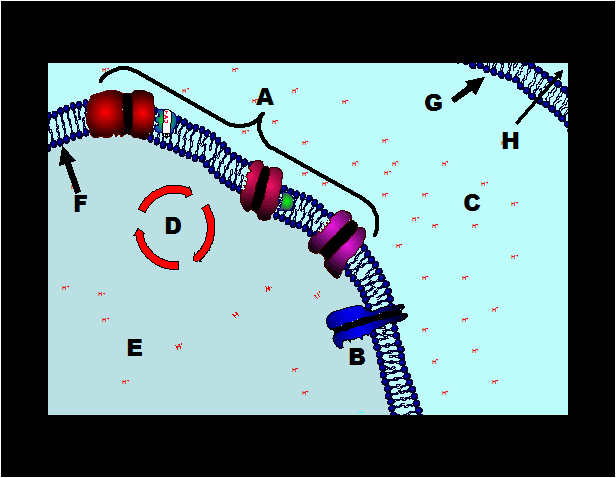 | electron transport system, |
| Through which set of proteins would protons flow freely using only passive transport? (Choose from A or B), | B, |
| What is the name of the protein complex labeled B?, | ATP synthase, |
| What does the protein complex labeled B do?, | Put a phosphate onto ADP to form ATP during chemiosmosis., |
| Through which set of proteins would protons travel through by active transport? (Choose from A or B), | A, |
| Which set of proteins is involved with chemiosmosis? (Choose from A or B), | B, |
| Which process does the letter D refer to?, | Kreb's Cycle?, |
| What is the name of the area where the letter E is located?, | The matrix of the mitochondria, |
What is the name of the area that the letter C refers to?,  | Intermembrane space of the mitochondria, |
| What is the name of the area that the letter H refers to?, | This area is outside the mitochondria, so it would be the cytosol of the cell., |
| What is the name of the membrane that F is pointing to?, | inner membrane of the mitochondrion, |
| What is the name of the membrane that the letter G is pointing to?, | Outer membrane of the mitochondrion, |
| In which direction would protons flow by facilitated diffusion (C to E or E to C) and why?, | C to E because the proton concentration is less in the area labeled E (the matrix) so protons would naturally flow from the area of high concentration to the area of low concentration by diffusion, |
| In which direction would protons have to be pumped using active transport (C to E or E to C) and why?, | E to C because there is already a higher concentration of protons in the intermembrane space (C).The protons don't want to go where it is more crowded so you have to use energy to get them there., |
What is the name of this organelle?, 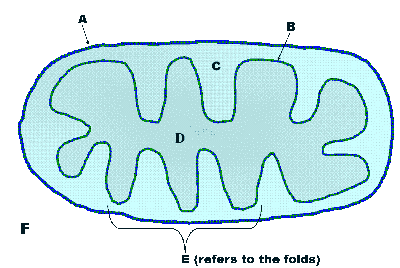 | mitochondria, |
| What are the folds in the membrane referred to by the letter E called?, | Cristae, |
| What is the area labeled D called?, | The matrix, |
| What is the area labeled C called?, | Intermembrane space, |
| What is letter A pointing to?, | The outer membrane of the mitochondrion. |
| What is the letter B pointing to?, | The inner membrane of the mitochondrion |
| What is the area labeled F called?, | That would be the cytosol of the cell. |
| Where would the proteins involved with the electron transport chain be located?, | B, |
| Where would the Kreb's Cycle take place, | D, |
| Where would glycolysis take place?, | F, |
| Where would the transition phase take place?, | D, |
| Where would protons (hydrogen ions) be building up during the electron transport chain?, | C, |
| Where would protons (hydrogen ions) be headed during chemiosmosis?, | D, |
| Where would ATP synthase be located?, | B, |
Which letter indicates where aerobic cellular respiration takes place?,  | B, |
| What does letter B refer to?, | a mitochondrion, |
| What does letter I refer to?, | The cytosol, |
| What happens to carbon dioxide that you generate inside cells during cellular respiration? | The carbon dioxide will diffuse out of the cell and enter the bloodstream. The bloodstream will pass the lungs where it will allow the carbon dioxide to diffuse into the lungs. From there, it is exhaled. |
| Acetyl-CoA is a __ -carbon molecule that enters the Kreb's Cycle by bonding to oxaloacetic acid, a ___-carbon molecule to form citric acid, a __-carbon molecule. | 2,4,6 |
| During the Kreb's Cycle, a ___ -carbon molecule is stripped down until it becomes a ___-carbon molecule before rejoining with acetyl-CoA to form a __-carbon molecule again. | 6,4,6 |
| What is the main purpose of the Kreb's Cycle. | The main purpose of the Kreb's cycle is to strip high energy electrons and hydrogen ions from high energy organic molecules, starting with citric acid (The Kreb's Cycle is sometimes called the Citric Acid Cycle because citric acid is the largest molecule in the cycle). |
| Which energy storing molecules are built up during the Kreb's cycle? | .,  |
| What is the main purpose of chemiosmosis? | ATP generation |
| During which stage of aerobic respiration is most of the ATP formed? | Chemiosmosis (34 ATP) |
| One molecule of glucose can result in __ turns of the Kreb's Cycle. | Two. Remember that glucose ends up forming 2 molecules of pyruvate which in turn forms 2 molecules of acetyl-CoA. One molecule of acetyl-CoA causes the Kreb's Cycle to cycle once, so two would cause two turns of the cycle. |
| During which stages of cellular respiration are ATP produced? | Glycolysis, Kreb's Cycle, and Chemiosmosis |
| During which stages of cellular respiration are NAD+ reduced to NADH? | Glycolysis, Transition stage, and Kreb's cycle |
| Which stage requires ATP to be broken down into ADP? | Glycolysis |
.,  | .,  |
| Which two stages of aerobic respiration are collectively referred to as oxidative phosphorylation? | electron transport and chemiosmosis |
| The electron transport system and chemiosmosis are collectively referred to as ______. | oxidative phosphorylation |


