| A | B |
|---|
| clavicle | collar bone |
| phalanges | tips of the finger |
| What is the radius attached to? | attached to the thumb |
| Where is the lombar vertebrae? | lower back |
| What is the ulna attached to? | attached to the elbow |
| What is the difference between metatarsals and metacarpals? | The metatarsals are the bones in your toes. The metacarpals are the bones in the fingers. |
| Which is larger, the tibia or the fibula? | the tibia |
| What is the knee bone? | the patella |
| What is the bone that you sit on? | the ischium |
| What is the tip of the tail bone? | coccyx |
| What is the top of the sternum? | minubrium |
| What are the tips of the bones and the tips of the fingers called? | phalanges |
| What part of the vertabrae runs up the neck? | the cervical vertibrae |
| Where is the gladeolus? | It is in the middle of the sternum. |
| What is the difference between false ribs and true ribs? | False ribs are not directly attached to the sternum. True ribs are directly attached to the sternum. |
| Where is the thoracic vertabrae? | middle of the back |
| Is the floating vertabrae attached to the sternum? | No |
| Where is the humerous? | It is in the upper arm |
| Where is the femur? | It is in the upper leg |
| What is the name of the heel bone? | calcaneous |
| flexion | 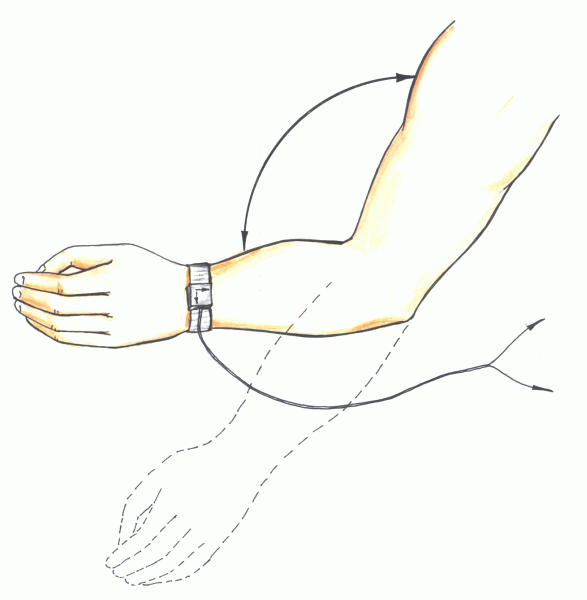 |
| eversion | 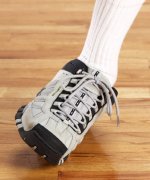 |
| supination pronation | 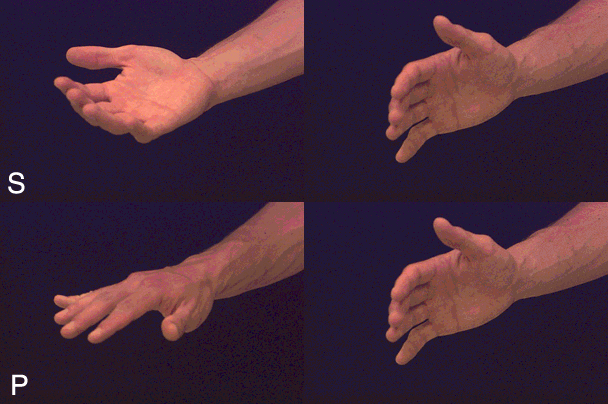 |
| What are the 5 functions of the skeleton? | 1.framework 2. protection of internal organs 3.movement (w/use of muscles) 4. makes blood cells 5. storing minerals |
| Where are joints? | where bones meet |
| What joints do not move? | Fixed joints |
| What are joints held together by? | ligaments |
| What is an example of a ball and socket joint? | shoulder |
| What is an example of a pivot joint? | elbow |
| What is an example of a hinge joint? | knees, fingers, and toes |
| What is an exapmple of a gliding joint? | wrist |
| T/F: Bones move due to the aid of muscle | true |
| What are muscles attached to bones by? | tendons |
| What are the three types of Muscle? | 1. smooth muscle 2. cardiac muscle 3. skeletal muscle |
| Is cardiac muscle movement involuntary or voluntary? | involuntary. |
| All of the following are tissues found in the skin except... connective, epithelial, muscle, cardiac | cardiac |
| What is not a function of the skeletal system? | regulating temperature |
| What is the sking migment that protects cells from solar radiation? | melanin |
| What is not found in the dermis? blood vessals, nerves, keratin, oil glands | keratin |
| When exposed to the sun, what does skin produce? | vitamin D |
| As a muscle relaxes after contraction, actin filaments... | slide away from each other |
| T/F: Skin plays a role in regulating body temperature | true |
| Ridges in the ______ of your skin give you a unique finger print. | epidermis |
| What goes to become mature bone cells? | osteoblasts |
| What are the most serious degree burns? | 3rd degree |
| What part of skin is destroyed in a 3rd degree burn? | dermis and epidermis |
| T/F:The fetal appendicular skeleton is mostly made up of cartilage. | true |
| _________ fills the cavaties of bones and is responsible for the production of red and white blood cells. | red marrow |
| What does the axial skeleton include? | skull, ribs, vertabral column, sternum |
| What is the fluid sac in movable joints that prevents bones from rubbing against each other? | Bursa |
| Epidermal cells in the skin are derived from the __________ | ectodermal layer of skin |


