| A | B |
|---|
| Another word for "cell membrane" | Plasma Membrane |
| Only allows certain materials in or out | Selective Permeability |
| The cell membrane is made of these | Phospholipids |
| The double layer of phospholipids is called | Lipid Bilayer |
| The ______ of the phospholipids repel water | Nonpolar Tails |
| The ____ of the phospholipids attract water | Polar Heads |
| Aid movement of substances in/out of cell | Transport proteins/Channel proteins |
| Speed up chemical reactions inside cell | Enzymes |
| Movement across a membrane without energy | Passive Transport |
| Passive transport happens because the body must maintain _____. | Homeostasis |
| In passive transport, molecules move from a ____ concentration a ____ concentration | high; low |
| Difference in concentration of a substance is called: | Concentration Gradient |
| When the concentration of a substance is equal throughout a space | Equilibrium |
| T or F? In equilibrium, the molecules stop moving. | False! Molecules are always moving! |
| The process of molecules moving from high concentration to low | Diffusion (passive transport) |
| The diffusion of water through a membrane | Osmosis |
| Type of solution where there's no net movement | Isotonic Solution |
| Solution that makes the cell swell | Hypotonic Solution |
| Solution that makes the cell shrink | Hypertonic Solution |
| What makes the cell swell in a hypotonic solution? | Turgor pressure/high water outside of cell |
| Hypertonic solutions cause ____ in a cell | Plasmolysis (cell shrinking) |
What type of solution is this?, 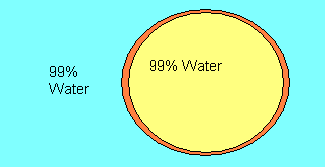 | Isotonic |
What type of solution is this?, 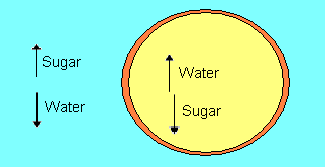 | Hypertonic |
What type of solution is this?, 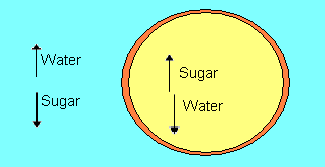 | Hypotonic |
What type of active transport is this?, 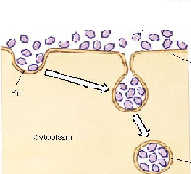 | Endocytosis |
What type of active transport is this?, 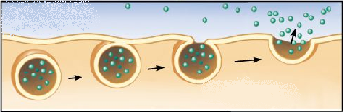 | Exocytosis |
| When substances require energy to move through a membrane, it is called: | Active Transport |



