| A | B |
|---|
Temple of Fortuna Virilis,  | Follows the Etruscan model of temple design. |
| Temple of Fortuna Virilis, | Engaged columns resulting in a pseudoperipteral temple. |
| Temple of Vesta | Erected on a dramatic site overlooking a deep gorge, sits back in the woods |
| Temple of Vesta | Imported the tholos (round) temple type from the Greeks |
| Temple of Vesta | The high podium can only be reached by a narrow staircase leading to the cella door |
| Temple of Vesta | Corinthian columns- acanthus leaves |
Head of a Roman Patrician,  | Republican portraits are one way the patrician class celebrated its elevated status |
| Head of a Roman Patrician, | One of the most striking of these so-called veristic (superrealistic) portraits is of an unidentified patrician |
| Funerary Relief with Portraits of the Gessi | This image depicts former slaves who have gained their freedom and right to have their portraits created |
Amphitheater, Pompeii,  | This word means “double theater”, and the Roman structures closely resemble two Greek theaters put together |
| Amphitheater, Pompeii, | Barrel vaults help support the structure as well as form tunnels leading to the arena |
| Brawl in the Pompeii Amphitheater | This painting depicts a scene of a fight that left many wounded and led to a 10 year prohibition against such events |
| Brawl in the Pompeii Amphitheater | This painting that is found on the wall of a Pompeian house depicts an incident that occurred in the amphitheater in A.D. 59 |
| Brawl in the Pompeii Amphitheater | This painting shows the cavea (literally a hollow place or cavity) in the ampitheater |
| Fauces | This is the throat of the Roman house |
| Atrium | The court of the Roman house, partly open to the sky, large central reception area |
| Impluvium | The basin located in the atrium that collected rainwater. |
| Cubiculum | A small cubicle or bedroom that opened onto the atrium |
| Tablinum | Home office |
| Peristyle | A colonnade |
| Triclinium | Dining room |
Barrel Vault, 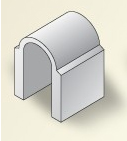 | Also known as a tunnel vault, made of concrete |
Groin Vault, 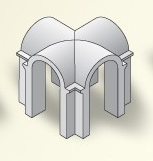 | Also known as a cross vault, intersects at 2 right angles of two equal sized vaults |
| Fenestrated Sequence | Sequence of groin vaults |
Hemispherical Dome, 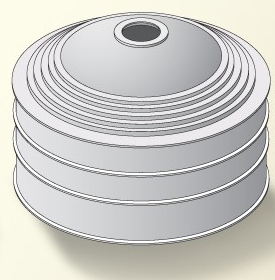 | Described as a round arch rotated around the full circumference of a circle. |
| Atrium of the House of Vetti | One of the best preserved houses at Pompeii, partially rebuilt and an obligatory stop on every tourist’s itinerary today |
| First Style Wall Painting | This has also been called the Masonry Style because the decorator’s aim was to imitate costly marble panels using painted stucco relief |
| First Style Wall Painting | This approach is comparable to the modern practice of using cheaper manufactured materials to approximate the look and shape of genuine wood paneling. |
| Dionysiac Mystery Frieze | In front of this marble wall, the painter created the illusion of a shallow ledge on which the human and the divine move around the room. |
| Dionysiac Mystery Frieze | This chamber was probably used to celebrate, in private, the rites of the Greek god Dionysus [Roman Bacchus]. |
| Dionysiac Mystery Frieze | Especially striking is how some of the figures interact across the corners of the room. |
Second Style Wall Painting,  | This cubiculum is a prime example of mature Second Style designs in which painters created a 3-D setting that also extends beyond the wall. |
| Second Style Wall Painting, | Linear perspective vs. intuitive perspective |
| Second Style Wall Painting, | The antithesis of the First Style |
| Second Style Wall Painting, | The painters wanted to dissolve a room’s confining walls and replace them with the illusion of an imaginary three-dimensional world, which they did only pictorially. |
| Gardenscape- Villa of Livia | Recession is suggested by atmospheric perspective |
Third Style Wall Painting, 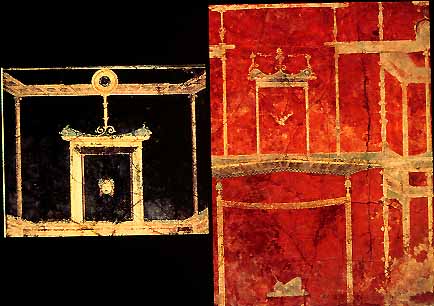 | Painters decorated the walls of their Roman patrons’ homes with delicate linear fantasies sketched on predominantly monochromatic (one color) backgrounds. |
| Third Style Wall Painting, | In place of the stately columns of the Second Style are insubstantial and impossibly thin colonnettes (a small column) supporting featherweight canopies barely reminiscent of pediments. |
Fourth Style Wall Painting,  | It is busier and more crowded and the use of bold colors, compared to the early fourth style where they focused on simplicity. |
| Neptune and Amphitrite wall mosaic | Shown here are Neptune, sea god, and his wife Amphitrite set into an elaborate niche. |
| Portrait of Wife and Husband | Originally formed part of a Fourth Style wall of |
| Portrait of Wife and Husband | Standard attributes of Roman marriage portraits are displayed here, the man holding a scroll and the woman holding a stylus and a wax writing tablet. |
| Still Life with Peaches | This illusion of light marks the furthest advance by ancient painters in representational technique; it would not be seen again until the Dutch in the 1700’s. |
| Still Life with Peaches | Roman painters’ interest in the likeness of individual people was matched by their concern for recording the appearance of everyday objects |



