| A | B |
|---|
 | Richard Pynson issued some two hundred books between 1493 and 1527 1492-1530. He was the royal printer to Henry VIII. His first dated book was the Doctrinale of Alexander Grammaticus, printed in 1492, but he printed several books before that date. In all, he printed more than 370 books. |
 | John Day, Daye or Daie was born in Dulwich. He came from a good family and his first printing office was in Holborn, London in about 1549. He perfected the Greek and italic types and cut the first Saxon types. He was buried in the parish church of Bradley in Suffolk. His grave has a tablet stone against the north wall of the chancel; it was erected in memory of his skills as a printer. |
 | Johann Weissenburger. Working period: Nürnberg, 1503 - 1513; Landshut: 1513 - 1531 |
 | Simon Vostre, ? – 1521. Working period: Paris, 1486, 1489 – 1520. Vostre printed and published in Paris at the sign of St. John the Evangelist on the rue Neuve Notre Dame, which served as the center of the commercial book trade. He is especially noted for producing many beautifully decorated versions of the Book of Hours, which grew out of the Church's cycle of prayer that divided the day into eight segments, or "hours." |
 | Benardinus Venetus de Vitalibus. (Together with Matthew de Vitalibus were called "Li Albanesoti"). Working period: Venice, 1494 - 1536; Rome, 1508, 1522 |
 | Unknown The unknown printer of St. Albans was the first to use a printers' mark in England. This one was used in the "English Chronicle" printed in 1483. Found: St Albans, 1480 - 1486 |
 | Peter Treveris. Working period: London, 1522 - 1532 |
 | Jehan Treschel. Working period: Lyon, 1488 - 1489 |
 | Andreas de Torresanos, 1451 – 1529. Otherwise known as: Torresanus, Tor(r)esanis, Andrea de Asula, Asola. Working period: Venice, 1475, 1480 - 1529 |
 | Michael Topie. Working period: Lyon 1488 - 1490 |
 | Jacob Thanner, ? - post 1530. Otherwise known as: Jacobus Thanner. Working period: Leipzig, 1501 - 1521 |
 | Stagino da Trino. Otherwise known as: Bernardino Ferrari Gialito, Stagino da Tridino, Da Monferra de Monteferrato. Working period: Venice, 1483 - 1518 |
 | Giovanni Battista Somasco. Otherwise known as: Joannes Baptista Somaschus, Jacques Saccon. Working period: Venice, 1576 -1589 |
 | John Siberch. Working period: Cambridge, 1521 – 1584. Siberch was the printer of Cambridge |
 | Valentin Schumann, ? – 1542. Working period: Damander, 1502-1534 |
 | Laurentius de Rubeis de Valenza. Otherwise known as: Lorenzo di Rossi. Working period: Rerra, 1482-1485?, 1489-1501 |
 | Johann Rosenbach. Otherwise known as: Joan, Juan Rosembach, of Heidelburg. Juan de Rosenbach, important in book making in Spain, printed in Barcelona in 1493-1498 Rosembach was German, but he is one of the most noteworthy names in the early annals of Spanish printing. He printed books in Barcelona, 1493-1498, and again at the beginning of the sixteenth century; in Perpignan, 1500; in Tarragona, 1490, and in Montserrat. In 1499, he printed a famous missal at Tarragona known as the "Missal de aquel Arzobispado." |
 | Dominicus Rocociola. Otherwise known as: Domincus Ragazulus. Working period: Modena, 1481 - 1509 |
 | Philippe Pigouchet. Working period: Paris, 1483 - 1515 |
 | Jean I Petit. Otherwise known as: Paryus, Pusillus. Working period: Paris, 1495-1530. His work was carried on by son Jean II Petit, working period: 1525-1543 |
 | Richardus Paffraet. Otherwise known as: Ryker Paffraet, Poffray, Paffroed de Colonia. Working period: Denventer, 1476 - 1511 |
 | Ehard Oglin. Working period: Hugsburg, 1505-1516 |
 | Julian Notary, 1498 – 1520. Otherwise known as: Juliyan Notary. He worked in London and Westminster and was responsible for printing about 40 books. The earliest of these, The Gospel of Nicodemus, was printed in 1507 and was very frequently reprinted. |
 | Sebastien Nivelle Worked with Henri Thierry et Olivier Harsy. Working period: Paris, 1549-1584 |
 | Ercole Nani. Otherwise known as: Hercules Nani. Working period: Bologna, 1423-1494; Rome: 1509 |
 | Colard Mansions, ? – 1484. Working period: Bruges, 1474-1484. The great printer of Bruges at that date, was one of the leaders in the art of typography. |
 | Melchoir Lotter, ? – 1542. Working period: Leipzig, 1491-1536 |
 | Zacharis Kallierges. Otherwise known as: Kalliergos. Working period: Crete, 1517 |
 | Luca(ntonio) A. Guinta, 1450 – 1519. Otherwise known as: Junta or Zunto of Florence. From 1480 to 1598 the Giunta (or Junta) family successively operated a printing establishment at Florence, and all used this emblem in their printers’ marks. After the Aldine press, the Giunta was the most famous in Italy. |
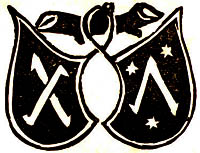 | Johann Fust, ? - c.1508 & Peter Schoeffer of Gernsheim, 1425* - 1503. This device was the earliest known printer's mark and the earliest to contain the typographers name, place and the date of printing. Johann Fust, and Fust’s son-in-law, Peter Schöffer, issued a Latin Psalter in 1457 the third book printed from movable type; it was the earliest to have a date, place, and typographer’s name on it; and, most important in the context of the Library windows, it was the first book to have a printer’s mark in it |
 | Johann Froben of Hammelburg, 1460 – 1527. Otherwise known as: Jean, Joannes Frobenius, Joannis Frobenii. He introduced Roman letters into Germany and produced Erasmus’ edition of the New Testament in Greek. |
 | Andreas Fritag de Argentina (Strasburg). Working period: Gaieta, 1487; Rome, 1492 - 1496 |
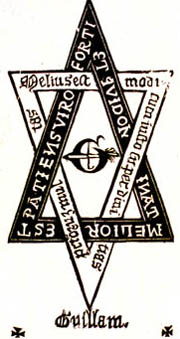 | William Faques, ? - c. 1508. Otherwise known as: Fawkes, Fakes, Faukes. Faques was the first Printer to the King of England in 1503. His printers mark is two interlinked triangles, one white and one black. These are symbols of the Holy Trinity. The words are in Latin and taken from Psalm 37 verse 16. The white triangle translates to mean "a small thing that the righteous that is better than great riches of the ungodly". The black triangle is from Proverbs 16 verse 32 and translates to "He that is slow to anger is better than the mighty; and he that rules his spirit than he who takes a city". |
 | Christopher Plantin, Antwerp (1520- 1589) founded one of the most successful printing companies, lasted 300 years after his death.Maintaining close connections with his native land throughout his life, this French-born Flemish printer had branch shops in Paris, Leyden, and Salamanca, and achieved a notable reputation with his Polyglot Bible an edition of the bible in hebrew, greek, latin, syriac and aramaic published in 1572. His printers mark consists of a compass. Here it is shown suspended by a hand from clouds, with a scroll around it reading "Labore et Constantia" ("By labor and constancy") |
 | Jean Du Pre. Otherwise known as: Johannes de Prato, Jehan Du Pre. The du Pre family are likewise celebrated in the history of printing in France. Their activity extends from 1486-1775. The founders, Jean and Galliot are the most celebrated of the family. |
 | Jacques Colomies. Working period: Toulouse, 1525 - 1550 |
 | Simon de Colines, 1480 – 1546 pioneered the use of italic type in france. He was the partner of Henri Estienne. He is credited with the design of italic and Greek fonts and of a roman face for St. Augustine's Sylvius (1531), from which the garamond types were derived. Otherwise known as: Colinaeus of Brittany, Symon Colinet |
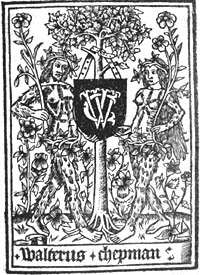 | Walter Chepman, c. 1473 – 1538 along with Andrew Myllar set up the first printing press in Scotland in 1508 in Edinburgh, their press closed in 1510. Known for printing vernacular poetic texts |
 | William Caxton [of County Kent], c. 1422 – 1491. Caxton was England's first printer. His chief goal was to furnish specialists and students with the best of literature, he paid little attention to details such as initials, signatures, pagination, and title pages. Clarity and correctness were of prime importance to him. His first book, the Dictes or Sayenges of the Philosophers, was the first book printed in vernacular. The design between the initials "WC" is thought to reproduce a merchant’s mark he used before becoming a printer, while the two small letters at either side which look like "S" and "C" are thought to stand for Sancta Colonia, the city of Cologne. |
 | Conrad Baumgarten. Otherwise known as: Baumgarthen, Bomgarthen. Working period: Danzig, 1499; Olomouc, 1500 - 1502; Breslau, 1503 - 1506; Frankfurt, 1506 -1509; Leipzig, 1514 |
 | Thomas Anshelm of Baden - Baden, ? – 1524. Possibly the most illustrious of the early Hagenau printers, Anshelm worked in Strassburg and Hagenau from 1488 to 1522. His printers mark consists of the initials "T.A.B." with a Hebrew inscription which represents the name Jehovah. |
 | Aldus Pius Manutius, 1450 –1515 Otherwise known as: Aldus Pius Manuzio, Aldo Pio Manuzio Bassanias (of Bassanio) later became Aldo Pio Manuzio Romanus. Aldus is owed the inventions of Italic type (cursive script) and the small portable format of books. Because he wanted to widen the audience for contemporary literary works in the vernacular as well as for texts of classical antiquity, he is responsible, too, for issuing these at reasonable cost.. The Aldine anchor, as it is known, first appeared in 1502 and is based on an ancient Roman coin or medal with the motto "Festia lente," meaning "Make haste slowly." The anchor represents stability, and the dolphin, grace and speed in execution. |



