| A | B |
|---|
| Cell | This is the structural and functional unit of all living organisms |
| Cell Membrane | A thin flexible barrier around the cell which regulates what enters and leaves the cell. |
| Cell Wall | This structure provides support and protection for plant cells. |
| Chlorophyll | This is a green pigment in chloroplasts that traps light energy from the sun. |
| Chloroplast | This is an organelle with chlorophyll in plants that photosynthesize. |
| Cytoplasm | This is a homogeneous generally clear jelly-like material that fills cells and serves as the broth of the cellular soup. |
| Eukaryote | These are cells where the genetic material is contained in membrane-bound nuclei. |
| Golgi Body | This organelle serves as the primary delivery system of proteins in the cell. |
| Mitochondrion | An organelle found in most eukaryotic cells whose primary function is to produce energy in the form of ATP |
| Multicellular | Organisms consisting of more than one cell |
| Nucleus | The structure that houses the cells genetic information. |
| Organelles | These are specialized structures that perform vital cellular functions within a eukaryotic cell. |
| Organism | Any living thing with one or more cells. |
| Plant | This is a living thing without the power of locomotion. |
Prokaryote, 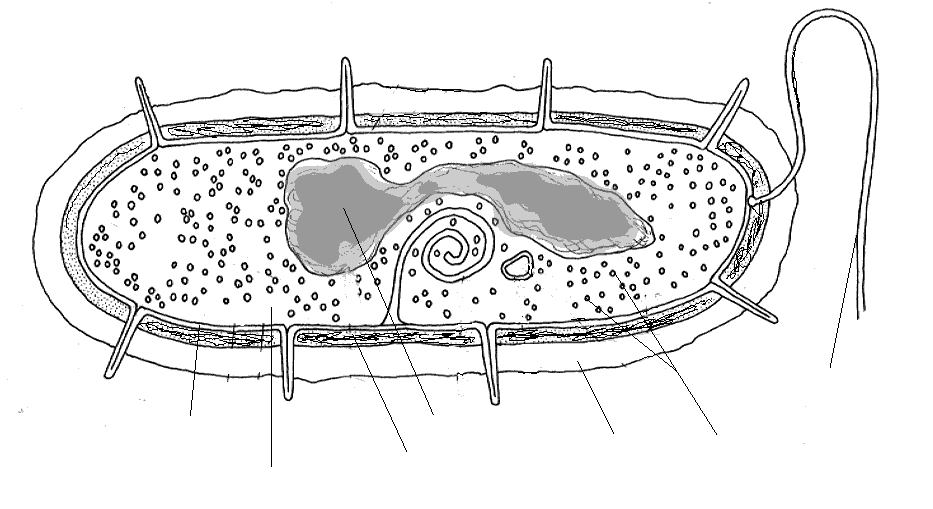 | These are organisms where the genetic material is not bound by a nucleus. They are usually unicellular. |
| Ribosome | This organelle synthesizes proteins. |
| Tissue | This is a group of cells with similar structure or function. |
| Vacuole | This is a tiny fluid-filled cavity in the cytoplasm that can be used for storage of biochemicals. |


