| A | B |
|---|
| supplementary angles | two angles whose sum is 180 |
| complementary angles | two angles whose sum is 90 |
| linear pair | two angles whose noncommon sides are opposite rays |
| congruent | measures are equal |
| adjacent angles | two angles with a common vertex, a common side and no common interior points (in other words, two angles that are next to each other) |
| two nonadjacent angles formed by two intersecting lines | vertical angles |
| segment bisector | intersects segment at midpoint |
| If M is the midpoint of AB, what do you know? | AM=MB |
| segment addition postulate | If C is between A and B, AC+CB=AB |
| obtuse angle | angle whose measure is >90 and < 180 |
| acute angle | angle whose measure is < 90 |
| right angle | angle whose measure is 90 |
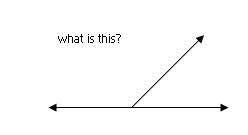 | adjacent angles and a linear pair |
Name the property: m| reflexive prop. (=) | |
| Name the property: If AB+BC=AC, then AC=AB+BC | symmetric prop. (=) |
| Name the property: If AB+BC=DE+BC, then AB=DE | subtraction prop. (=) |
| Name the property: If (3)(2)=6 and 6=4+2, then (3)(2)=4+2 | transitive prop. (=) |
| Name the property: If 3x=15, then x=5 | division property (=) |
| Name the property: AB+BC=BC+AB | commutative property (=) |
| If x/2 = 20, then x=40 | multiplication property (=) |
If x = 22, find y, 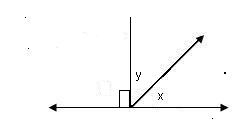 | y=68 |
If m<1=62, find m<2,3,4, 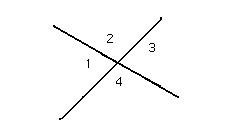 | m<2=m<4=118 and m<3=62 |



