Salvēte, discipulī!
TEST PREP EDITION!
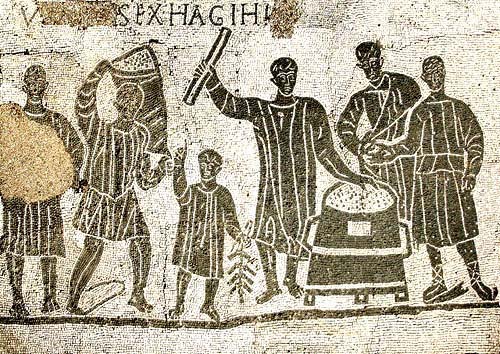
FESTINA LENTE!/MAKE HASTE SLOWLY!
CARPE DIEM!/SEIZE THE DAY!
ORA ET LABORA!/PRAY AND WORK!
WORK IN THE A.M. = ANTE MERIDIEN = BEFORE THE MIDDAY
AND
WORK IN THE P.M. = POST MERIDIEN = AFTER THE MIDDAY :)
SEMPER FIDELES/ALWAYS FAITHFUL! [LOOK FOR MORE LATIN SAYINGS THAT CAN ALSO BE ON THE EXAM BELOW]
VERBS ARE UP! Please read through the review, and then work on the first 9 activities below.
VERBS:
NOTA BENE/N.B./NOTE CAREFULLY For this exam, you must know the present, imperfect, infinitive and imperative (commands). It is good also that you know the future.
PERSON MARKERS
-M/-Ō = EGO = I -MUS = NOS = WE
-S = TU = YOU -TIS = VOS = Y'ALL
-T = IS/EA/ID = HE/SHE/IT -NT = IĪ/EAE/EA = THEY
STEM = SECOND PRINCIPAL PART (THE INFINITIVE), MINUS THE -RE
exempli gratia/e.g.,/for example,
'LOOK' SPECTŌ, SPECTĀRE; STEM = SPECTĀ-
'HOLD' TENEŌ, TENĒRE; STEM = TENĒ-
'WRITE' SCRIBŌ, SCRIBERE; STEM = SCRIBE- (AND THE -E- WILL CHANGE TO -I- AND TO -U- SOMETIMES]
'SLEEP' DORMIŌ, DORMĪRE; STEM = DORMĪ-
PRESENT
TAKE THE STEM AND ADD THE PERSON MARKERS. REMEMBER THAT PERSON MARKERS THAT DO NOT END IN -S ARE MEAN AND KNOCK OFF THE MACRON IN THE STEM, IF ANY.
TRANSLATION = 'eats' 'does eat' 'is eating'
-3rd family: the -e- of the stem will disappear before the -ō (I), change to -i- for everything else, EXCEPT before -nt (THEY), when it changes to a -u- [scribō, scribis, scribit, scribimus, scribitis, scribunt]
-4th family: the -ī- stays throughout; before -nt we add a -u- [audiō, audīs, audit, audīmus, audītis, audiunt]
IMPERFECT

ADD THE INFIX -BĀ-, AND THEN THE PERSON MARKERS.
TRANSLATION = 'were doing', 'used to do', 'kept doing'
IMPERATIVE:
COMMAND TO ONE PERSON = STEM
COMMAND TO MORE THAN ONE PERSON = STEM + TE
Venīte! 'come' to more than one
Scribe! 'write' to one person
INFITINIVE = SECOND PRINCIPAL PART
ALWAYS ENDS IN -RE
TRANSLATION = 'to ____'
scribere 'to write'
cantāre 'to sing'
DECODING VERBS
When we decode verbs, we start from the end. Let's take the verb audiō, audīre, audīvī, audītus (these are the four principal parts from which we make all the verb forms) 'hear':
audiēbās =
-s tells us the subject is 'you'
-bā- tells us it is past, the video past 'were'
audī- tells us the verb, 'hear'
'you were hearing' 'you used to hear' 'you kept hearing'
audīre
-re is the end of the infinitive
'to hear'
audiēs
-s tells us the subject is 'you'
-ē- this long e tells us that we are in the future (the future for the 4th family of verbs is H-AM-Ē, HAMMY, remember? 'will'
'you will hear'
audīs
-s tells us that the subject is 'you'
audī- is the present stem (i.e., the second principal part, the infinitive, minus the -re), with nothing else added, so this tells us it is present time
'you hear/are hearing' 'you do hear'
audī
this is the stem of the verb, from the second principal part, the infinitive, minus the -re
this is the imperative, a command to one person
'listen!'
audīte
-te is the plural imperative
'listen!'
VERB SUM, ESSE, FUĪ, ---- IN THE PRESENT AND IMPERFECT
PRESENT
SUM 'I AM' SUMUS 'WE ARE'
ES 'YOU ARE' ESTIS 'Y'ALL ARE'
EST 'HE/SHE/IT IS' SUNT 'THEY ARE'
IMPERFECT
ERAM 'I WAS' ERĀMUS 'WE WERE'
ERĀS 'YOU WERE' ERĀTIS 'Y'ALL WERE'
ERAT 'HE/SHE/IT WAS' ERANT 'THEY WERE'
I've left a review below of the future tense. Read through if you have time, why not? :)
Valete,
Magistra
CRĀS means 'tomorrow.'
The endings for regular, 1st and 2nd family verbs in the future are:
BŌ, BIS, BIT, BIMUS, BITIS, BUNT

The first family/conjugation of verbs ends in -ĀRE.
The second family/conjugation of verbs ends in -ĒRE.
To make the future, you take off the -RE, and you end up with the present stem. Then you add the code you need.
So,
CANTĀBŌ 'I WILL SING'
SEDĒBIS 'YOU WILL SIT'
VOCĀBIT 'HE/SHE/IT WILL CALL'
VIDĒBIMUS 'WE WILL SEE'
INTERROGĀBITIS 'Y'ALL WILL ASK'
TENĒBUNT 'THEY WILL HOLD'
We noticed that the future of the irregular verb ESSE 'to be' has the same pattern of endings, without the -b-, stuck onto the stem ER-:
ERŌ 'I WILL BE'
ERIS 'YOU WILL BE'
ERIT 'HE/SHE/IT WILL BE'
ERIMUS 'WE WILL BE'
ERITIS 'Y'ALL WILL BE'
ERUNT 'THEY WILL BE'
Now for the 3rd and 4th families!
The 3rd family/conjugation of verbs ends in -ERE. To form the future, we drop off the whole ending, the whole -ERE!
There are some 3rd family verbs (how weird are they!!!) that are called -i stems. You can tell a verb is an i-stem if it has an -iō at the end of the first principal part, and -ere (like all 3rd family verbs) at the end of the 2nd principal part.
e.g., faciō, facere 'I make/do', 'to make/do'
These 3rd family i-stems put an i at the end of the stem to make the future. See examples below.
The 4th conjugation of verbs ends in -ĪRE. To form the future, we drop off the -RE.
For the 3rd and 4th families, to make the future, you take the stem given above and you add -AM for the 1st person singular (I). For all the other persons (you, he/she/it, we, y'all, they), you add an ē (notice the long mark!) and then add the person marker you need (-s, -t, -mus, -tis, -nt).
I remember these endings by calling the 3rd/4th future verbs "(H)-AM -Ē" ("HAMMY" like when a person acts like a 'ham'). -AM for the 1st person singular; -Ē and the person markers for every other person and number.
So,
ascendō, ascendere 'I climb, to climb' (3rd)
ascendam 'I will climb'
ascendēs 'you will climb', etc.
faciō, facere 'I do, to do' (3rd i-stem)
faciam 'I will do'
faciēs 'you will do'
faciet 'he/she/it will do', etc.
veniō, venīre 'I come, to come' (4th)
veniam 'I will come'
veniēs 'you will come', etc.
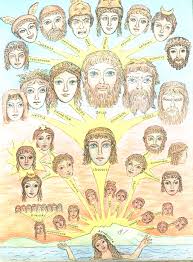
LOOK AHEAD TO THE GODS AND GODDESSES: DO YOU KNOW ALL THEIR NAMES IN LATIN AND IN GREEK? DO YOU KNOW THEIR SYMBOLS AND THEIR ATTRIBUTES?
|
|


