Important Semester Dates
- January 20: First translation due
- January 21: First live session together
- March 16: National Greek Exam
- March 25: Spring Break - No Class
- May 1-5: Final Quiz
- The password for recordings this semester is Artaxerxes

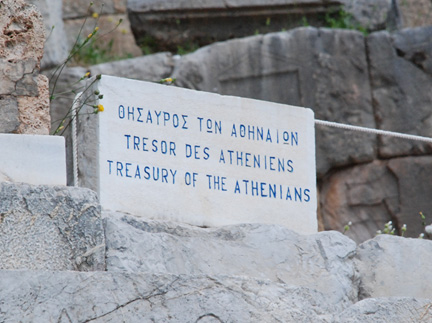
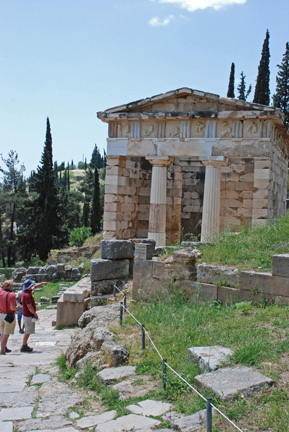
The Treasury of the Athenians at Delphi, Greece
We'll be concentrating on reading undiluted Greek this semester. This class assumes that you have completed your study of Greek grammar using Oxford's Athenaze I and II, or an equivalent text.
Class Format
The goal of a reading course is to do just that: READ GREEK! Nothing will increase your proficiency faster than plowing your way headfirst through some serious Greek texts. So you will prepare texts for translation and discussion prior to the class session. During class we'll discuss the background of the author and may take time to note characteristics and idiosyncrasies of his Greek; but we'll spend our time translating.
I’ve chosen texts that give you a lot of help – not just with vocabulary, but also with some of the more obscure points of grammar. This means that you shouldn’t have to spend a great deal of time in a Greek-English lexicon, and can instead focus on reading Greek. In addition, I'm going to share some resources with you that if used properly, will speed your acquisition of Greek. If abused, however, they'll slow your progress and make you dependent on them. The goal is to learn the text well and to fully understand it using nothing but the Greek itself by the time you get to class.
Course Expectations and Requirements
- Complete the assigned translation and submit it by the deadline each week
- Attend weekly classes, arrive on time, and stay for the entirety of the class session
- Actively participate in the live, online class session
- Use the text, class discussion, and your own research and review methods to improve your mastery of the Greek language
- Be prepared to translate any part of the passage aloud and explain the grammar in class
- Complete all required assignments on time and without reminders from the instructor
- Submit all assignments and quizzes as stipulated in other parts of this syllabus or presented in class
Textbooks
- Required: Xenophon's Anabasis by Maurice W. Mather and Joseph William Hewitt (University of Oklahoma Press, 1962)
- Optional: The Brill Dictionary of Ancient Greek by Franco Montanari (Brill, 2015)
For the serious student, this is a comprehensive Greek-English dictionary that is easier to read than the Greek-English Lexicon by Liddell & Scott (LSJ). Despite a hefty price tag, it’s still less expensive than the LSJ.
- Optional: The Landmark Xenophon's Anabasis edited by Shane Brennan and David Thomas (Pantheon Books, 2021)
The Landmark series of books are a great resource because they include extensive commentary, charts, maps, etc. Although the text is in English, this is probably the most comprehensive resource you'll find on the Anabasis.
- Optional: Introduction to Attic Greek, 2nd edition, by Donald J. Mastronarde (University of California Press, 2013)
This is the book that I often use as a reference grammar. I find it more detailed than Athenaze, and its Index and Contents are easier to use.
- Optional: Greek Grammar by Herbert Weir Smyth (Harvard University Press, 1984)
This is reprinted from the 1920 edition, revised in 1956, and is considered by many to be the gold standard authority on Greek Grammar. It can be a little difficult to use, partly because the wonders of modern computer-assisted typesetting and layout were not yet available, but it is comprehensive and it cites examples from throughout Greek literature. If you want the granddaddy grammar, choose this over Mastronarde (above).
Class Documents
Fonts
The default font used in Quia (Arial Unicode MS) can be difficult to read. We will use the IFAO-Grec Unicode font. You MUST have this font installed on your computer for the Greek characters to display properly in the homework and quizzes - the link to the download page is below. Even so, Quia will use its default font on any of your answer entry boxes; I cannot change that.
|
|

