| A | B |
|---|
| earthquake | the shaking and trembling that results from the movement of rock beneath Earth's surface |
| stress | a force that acts on rock to change its shape or volume |
| shearing | stress that pushes a mass of rock in two opposite directions |
| tension | the stress force that pulls on the crust, stretching rock so that it becomes thinner in the middle |
| compression | the stress force that squeezes rock until it folds or breaks |
| deformation | any change in the volume or shape of Earth's crust |
| fault | a break in Earth's crust where slabs of crust slip past each other |
| strike-slip fault | shearing creates this, where as the rocks on either side of the fault slip past each other sideways with little up-or-down motion |
| normal fault | the fault is at an angle, so one block of rock lies above the fault while the other block lies below the fault |
| hanging wall | the half of the fault that lies above the landform |
| footwall | the half of the fault that lies below the land landform |
| reverse fault | just like a normal fault, but the blocks move in the opposite direction |
| fault-block mountain | this is when normal faults uplift of block of rock this forms |
| folds | bends in rock that form when compression shortens and thickens part of Earth's crust |
| anticline | a fold in rock that bends upward into an arch |
| syncline | a fold in rock that bends downward in the middle to form a bowl |
| example of an anticline | 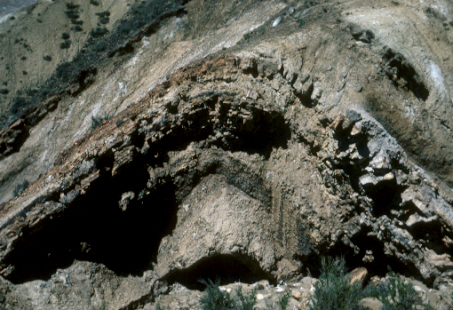 |
| example of a syncline | 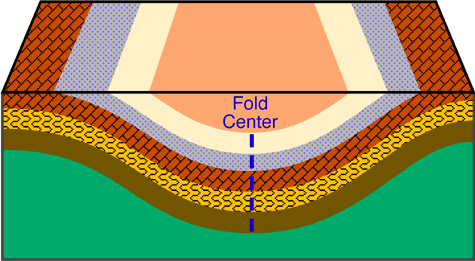 |
| Fracture | break in a rock |
| elevation | distance above or below sea level |
| Folded Mountains | Moutains formed by the folding of rock layers. These form when the continents collide |
| Fault-Block Mountains | These form when one side of a fault slips up past the crust on the other side. If the blocks are pushed up enough this moutain is formed. |
| Dome Mountains | These mountains form when magma rises through the crust and pushed up rock layers above it. The pushed up rock layers are worn away leaving separate peaks. |


